The quiet next door
The rare, perfect quiet places matter. So does the ordinary quiet of home, and that’s the kind we’re losing to data centers.
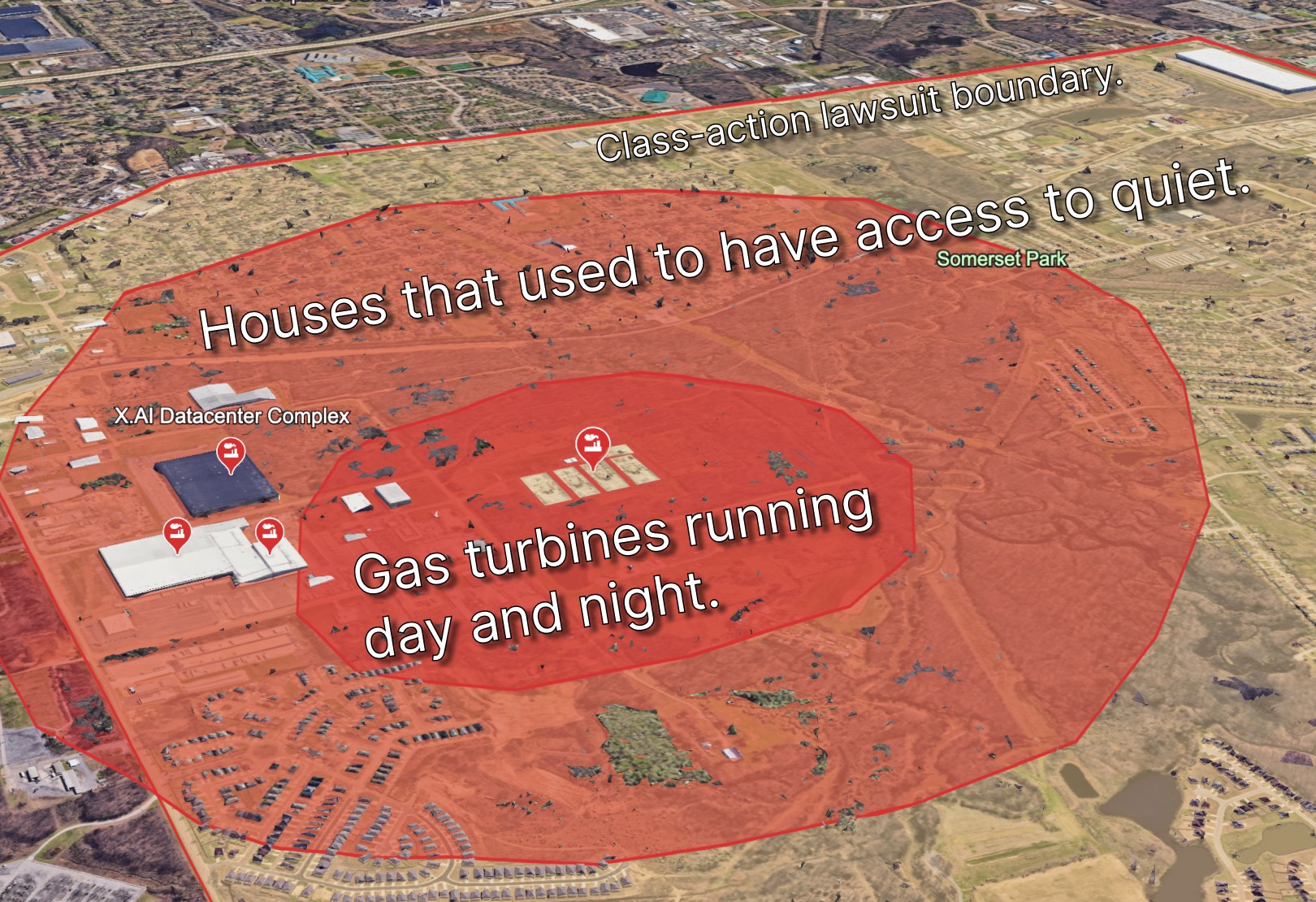
It sounds like an airplane engine.
Elizabeth Rose, Southaven resident, to The Guardian
Map: Google Earth, annotated by Nicholas Sherman
The short version
- Where
- Colonial Hills, a neighborhood in Southaven, Mississippi, about 15 minutes from Memphis
- What
- Dozens of gas turbines (69, by The Guardian’s count) powering Elon Musk’s xAI data centers, running since August 2025. 11 were switched off in August 2026; the company says the rest will go by July 2027, replaced by a permanent 41-turbine plant.
- How loud
- Residents’ own meters read in the 50s and 60s (decibels) at night. The WHO guideline for outside a bedroom is 40. Southaven lets industrial sites make up to 70, measured at their fence line.
- The offer
- xAI is reportedly targeting up to 418 homes, bought at market value if the owners stay out of the noise lawsuit
- Renters
- No offer. At least one has been given 60 days to leave.
- Who’s fighting it
- Three residents in a class action over the noise; separately, the NAACP with the Southern Environmental Law Center and Earthjustice over the air pollution
The longer version
They bought houses on an ordinary street and then one day found a power plant at the end of it. I’ve read a few articles on this now, in Forbes, The Guardian, CBS News and, closer to where it’s all happening, Mississippi Today. It’s the kind of story we’re likely to be hearing more and more of.
It’s not about the kinds of “perfect” quiet places we set out to document in Soundtracker. Those are rare, they’re located far away from most of us, and, by design, we keep most of them a secret so that people don’t flock to them. But there’s another kind of quiet place that is just as important. The “normal” ones. The ones most of us, if we’re lucky, have access to on a daily basis. They’re not free from noise, but they are a place where something resembling peace and quiet can be found. For most people, this is the quiet of our own homes. And usually, this quiet only gets disturbed temporarily, like when a nearby neighbor has a loud party, or decides to extend their house with a construction project. It’s annoying, but we cope with it, and try to be good neighbors.
But for the residents of Colonial Hills, a neighborhood in Southaven, Mississippi, it’s a different story. Elon Musk’s xAI took over an old Duke Energy site nearby and filled it with gas turbines to run its data centers, 69 of them by The Guardian’s count. They’re supposed to be temporary, but they’ve been running since August of last year and only recently has the company said when they’ll stop. Local residents say the noise sounds like an airplane engine that just never switches off. Jason Haley, who has owned his house there for 20 years and is now the lead name on the lawsuit, told The Guardian he either leaves the house or puts music on until he’s too exhausted not to sleep.
To be fair, there’s been some news that sounds like progress. At the end of August, SpaceXAI said it had switched off 11 of the 69 turbines, and it has promised the rest will be gone by July 2027. That definitely sounds like a good sign, and I really hope it happens. These turbines are being replaced by a permanent power plant with 41 turbines of its own, which is supposed to be, according to the mayor, “much more quiet.” Can we take their word for it? In 2016, Elon Musk said SpaceX would be sending people to Mars by 2024. In 2019, he said Tesla would have a million self-driving robotaxis on the road by the end of 2020. I’ll believe it when I hear it.
Some residents have started measuring the noise themselves with decibel meters, and they report readings in the 50s and 60s late at night. I don’t know how accurate those numbers are, but if they’re anywhere close, that’s a LOT louder than the World Health Organization’s guideline for night-time noise outside a bedroom, which is 40 decibels. Above 55, the WHO says, the risk stops being about sleep and starts being about your heart. And because decibels are logarithmic, a sound that is 60 dB is 4 times as loud as one that is 40 dB. That’s a lot.
In response, people are suing. It’s a class action lawsuit, and rather than wait for the courts, xAI has started buying the homes of the people most likely to join it. A realtor working the neighborhood told one resident the target is 418 houses, close to the whole of Colonial Hills, according to a recording The Guardian heard. Basically, if you agree to stay out of the lawsuit, and you’re a homeowner (sorry, renters, you’re out of luck), they’ll buy your house from you at market value. If you were already looking to sell your house, or move, this isn’t such a bad deal. But what if you like where you live, are friends with your neighbors, have a whole community that you’ve come to know and love? What if your kids are happy in their schools and with their friend group? If it were me, I’d definitely want to be compensated for the value of my home at market price, but I’d also need to be compensated for all the other things I’m giving up, the things that make our homes not just an investment in real estate, but part of the fabric of our lives and well-being. How much is that worth? 2x market value? 5x? I don’t know. That’s up to each individual to decide for themselves.
It should be noted that I’ve never been to Southaven, Mississippi. It looks like it’s 15 minutes from Memphis by car and an even shorter drive to the Mississippi River. And I don’t know the first thing about what kind of neighborhood Colonial Hills is. But this isn’t likely to be an isolated example. Depending on how you count them, somewhere between about 400 and 540 data centers are under construction in the US right now, with another 1,000 to 2,500 planned (DC Map, Cleanview). And it isn’t only the US: the property firm JLL expects global data center capacity to nearly double by 2030, so those numbers will just keep going up.
AI can be great, and data centers can create good jobs for people who need them. A few years after I shot Soundtracker, I moved my family to Oxford, UK and helped lead an Oxford AI spinout, and I loved every day of it. Today, I use AI daily in many of my workflows. It didn’t write any of this article, but a Google Alert for “noise pollution” found the original story, then sent it into some of my automation flows, which found more reporting on the issue and sent me the summaries. And when I make a shorter version of this post for LinkedIn, X or Instagram, I’ll definitely use AI for most of that. I used AI last month to finally bring the Soundtracker website out of its early iWeb 1.0 version and into the modern era, I use AI to vibe code new app ideas I come up with, I use it to get better at marketing, and increasingly I’m looking into how AI-generated video can be combined with traditional filmmaking techniques to create films that I never would have been able to make before. So, a lot of what I do depends on these data centers, and it’s quite possible that I’m just as much a part of the problem as Elon Musk is. It’s complicated, and I’m still trying to figure that part out.
So what do we do about this?
Unfortunately, I don’t have the answer. I’ve got a lot of questions, but not a lot of answers at the end of them. But here are a couple of suggestions that I feel comfortable sharing.
1. Learn to appreciate quiet
Go outside today and listen. Find a comfortable place to stand or sit in your backyard or balcony, or local park, and listen for a few minutes. The first time you think you’ve listened long enough, just keep listening until your mind tries to give up 2 or 3 more times, that’s usually when the really good listening starts to happen. Try to enjoy it. Hopefully it’s nice. It might not be. There’s a lot of noise in this world, and we can’t control that. Then do it again at night. It will be quieter. Notice the difference between the two. If you’re really geeky, download a free decibel app on your phone and take a reading. If a data center goes up in your neighborhood next year, at least you’ll have a baseline of what quiet used to be in your neighborhood. But the decibel reading isn’t the important thing, the important thing is that nobody will want to preserve quiet unless they actually care about it, and you won’t care about it if you never take the time to listen to it. So just go and listen.
2. Find your town’s noise ordinance
A noise ordinance is a town’s own law about noise: how loud things are allowed to be, at what time of day, and where the noise gets measured. Many places in the USA will have an actual number (different for residential versus commercial areas). In the UK, it’s a lot more subjective and based on context. Don’t know how to find your town’s noise ordinance? Try this:
- US towns: Google it! That’s what I did. Search for “[insert your town’s name] municipal code noise.” You can also go straight to the sites many towns use to upload their documents like this (Municode, American Legal, eCode360, town.codes) and search for “noise”. They’ll usually pull a dozen documents that talk about noise and chances are the one you’re looking for will be among that group.
- UK councils: Google it! Search for “[insert your council’s name] noise nuisance”. Unfortunately, there usually won’t be a number, just a complaint process. New construction developments will have actual numbers in the planning conditions, but those aren’t as easy to find.
3. Find out who can help you fight noise pollution
If you’re in Colonial Hills and want to know more about the lawsuit, Haley v. xAI, the firms have put up a plain-language FAQ on what actually gets signed away when someone takes a buyout. This is interesting reading even if you live nowhere near Mississippi. Beyond that lawsuit, there’s also a bigger legal fight taking place over the air pollution from the same turbines. That one is being run by the NAACP with help from the Southern Environmental Law Center and Earthjustice.
For the rest of us who don’t live in Mississippi, there are two “Quiet Friendly” groups I’d point you to.
Quiet Parks International. Gordon Hempton, aka the “Soundtracker” from the film, co-founded Quiet Parks International (QPI) in 2019. QPI finds and certifies quiet places, and they have a category for ordinary residential “quiet communities”, which is what Colonial Hills probably was until last August.
Quiet Communities is another advocate for quiet. They started out fighting leaf-blower and landscaping noise, and they’ve recently started working on data center noise too. Their advisers help local neighborhoods learn what protections to ask for before a data center shows up, and what to do if one already has. They are located in Massachusetts.
4. Brainstorm definitions of what failure looks like
Let’s not be the frog in a pot that’s slowly coming to the boil. Let’s experiment with AI and see what good things it can bring to society, but let’s also draw a line in the sand so that we know what failure looks like, instead of just changing our definition of it every time we get close to it. I’ll get the brainstorming session going with two of my own suggestions, please add your own by email or on LinkedIn (links below).
We’ll know we failed when… the standard remedy for noise is buying the neighborhood.
I think what we’re all hoping for here is quieter machines and quieter factories, not fewer people around to hear them. If buying up whole neighborhoods becomes the de facto way to settle data center noise pollution disputes, then we’ve failed. We’ve taken quiet, one of our most precious natural resources, and priced it as a nuisance, not as something people have a right to.
We’ll know we failed when… you can’t find a quiet back yard within an hour’s drive of a data center.
When we made Soundtracker 16 years ago, most of the conversation was about the last truly quiet places, the Hoh Rain Forest and places like it, and those still matter a great deal. But we shouldn’t forget about an even bigger loss that is happening in ordinary neighborhoods, where nobody thinks of the quiet as something to protect until it’s gone. A back yard where you could hear birds isn’t wilderness, but for most people it’s the only quiet they’ve got. So how could we create a map of how quickly we are losing these Quiet Backyards and how should we measure what qualifies as one? When Gordon talks about quiet places he usually means a place you can record for 20 minutes with a sensitive binaural microphone and not hear a single noise intrusion. For our Quiet Back Yard measurement we’d need something different. How would we define quiet? How would we define noise? For how long would you need the quiet to last in order to count it? What times of day? Send me your thoughts by email or on LinkedIn if you’ve got some suggestions.