Listening to the Pacific Crest Trail
Field recordist Tom Kelly walked the whole Pacific Crest Trail with his microphones, and put 200 of his recordings on a map anyone can explore.
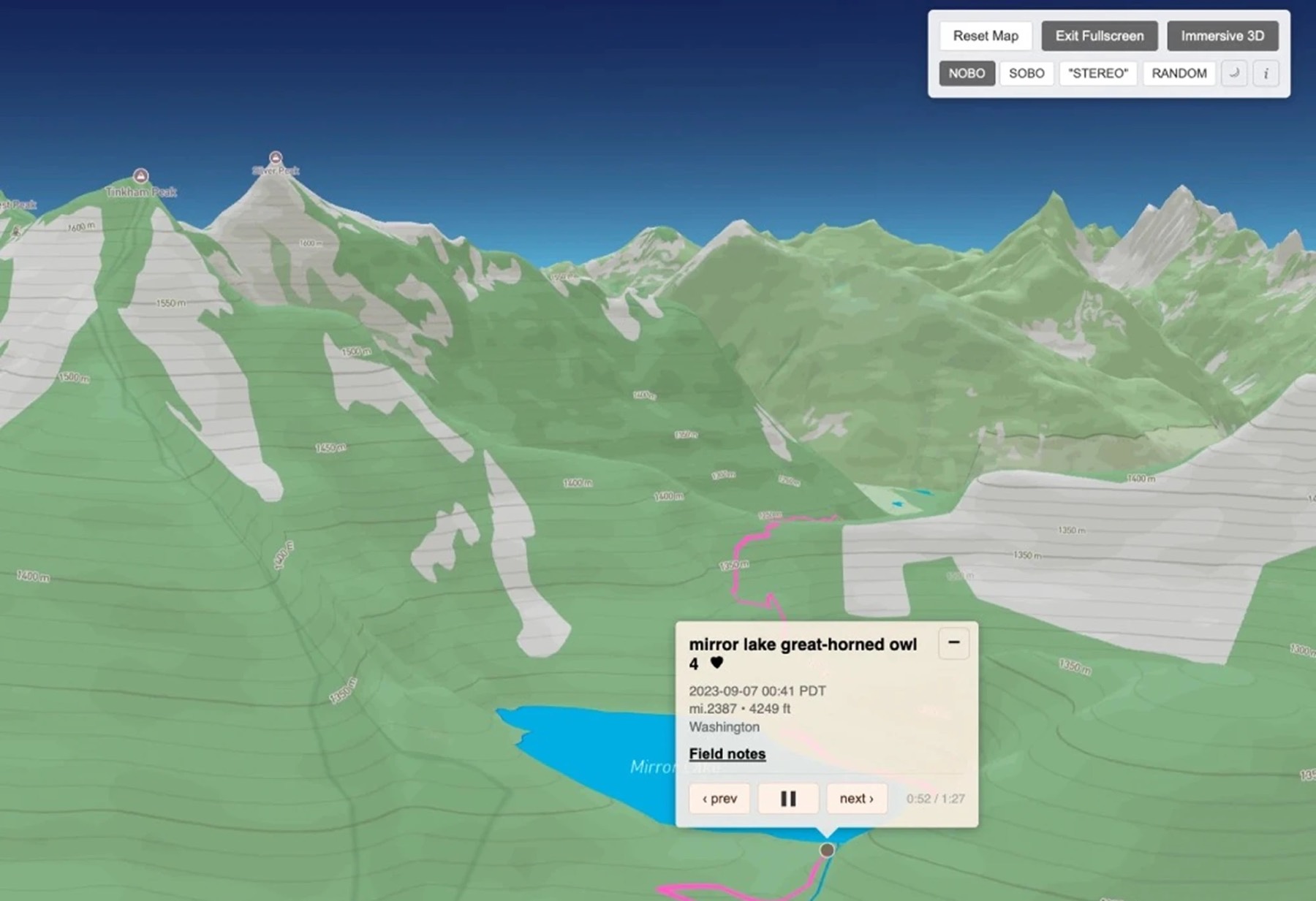
Map: thomasmkelly.com/pct-soundmap
The short version
- What
- 200 field recordings from a 2023 thru-hike of the Pacific Crest Trail, each pinned to the spot on an interactive map where it was made
- Who
- Field recordist Tom Kelly, trail name “Stereo” (@___tomk on Instagram)
- How long
- Most run a few minutes. A few are under a minute, a few over ten.
- Gear
- Two omnidirectional microphones, often clipped to trees or plants, on a handheld recorder (a Sony A10 with LOM Usi mics, later a Zoom F3 with Sennheiser MKH 8020s). Stereo, not binaural.
- How to listen
- Over-ear headphones, with the map in “Immersive 3D”
- Where
- thomasmkelly.com/pct-soundmap
The longer version
In Soundtracker, Gordon Hempton spends most of the film searching for places where you can listen for a long time without hearing a plane, a car or a person. Field recordist Tom Kelly did something similar on foot. He walked the whole Pacific Crest Trail in 2023 with a pair of microphones, and according to the San Francisco Chronicle, he deliberately avoided recording noise from people and aircraft along the way.
That’s about 2,650 miles, from the Mexican border to Canada. He made around 350 recordings on the way, and he’s now put 200 of them on a very cool interactive map of the trail, each one pinned to the spot where he made it, with the mile marker, the elevation, the date and a short field note. It’s free, and it’s available for anyone to explore.
What I like most about it is a tension Tom writes about on the map’s About page. Field recording, he says, needs “stillness within a space over a period of time,” and a thru-hike is the opposite, you have to keep moving every day or you don’t make it to Canada. So every recording on that map is a moment where he decided to stop.
How to listen
My recommendation: grab some over-ear headphones, put the map into “Immersive 3D”, and spend the next hour going on your own sonic tour of one of America’s greatest trails. Tom’s recordings aren’t binaural like Gordon’s (more on that below), but they’re stereo and beautifully made, and headphones are still the best way to hear them. If you don’t know where to start, there’s a button on the map called “Random”.
Binaural vs. stereo
My favorite
I was looking for some of the sounds that I grew so familiar with while filming Soundtracker: western meadowlark, blue grouse, mosquito, coyote, freight train. I found a couple of them. There’s a sooty grouse (one of the two birds that used to be called the blue grouse) at mile 2,422.5, and some Oregon mosquitoes buzzing around a cricket at mile 1,787.8. No meadowlarks and no freight trains, though. But I did find a beautiful owl recording. Look for “Mirror Lake Great-Horned Owl 4”, recorded at Mile 2,387, at an elevation of 4,249 feet, in Washington. It’s from just after midnight on September 7th, 2023, and according to his field notes Tom got up, a little reluctantly, in the middle of the night to record “our nighttime visitor.” It’s a good 90 seconds, and features an owl calling from across the lake, and the beautiful quiet in between the calls. Hoot. Hoot.
Not all of it is quiet
These days, you can’t go many places with sensitive microphones and record for more than a few minutes without capturing some kind of man-made noise intrusion. Tom did a good job keeping people and planes out, but not every recording is pristine, and I think that’s just the reality of the geography of America today. Alongside the recordings of creeks, the owls and the dawn choruses, we also find the wind farms in the Mojave, transmission lines with crickets underneath them, and construction along a reservoir fence. It’s an honest, historical artifact of what a long walk through the American West actually sounded like in 2023, warts and all. Tom says he hopes it gives access to people who may never set foot on the trail, and I think that’s a beautiful invitation. It’s also a pretty good baseline, if anyone ever wants to go back and find out what’s changed.
If you find a favorite of your own, let me know. And if you enjoy it, the map has a “Support me” button, which is a nice way to say thank you to Tom.